
Struggling with smart appliances that keep disconnecting from your home network or security cameras that drop offline every time someone uses the microwave? You’re experiencing one of the most frustrating connectivity nightmares plaguing modern Canadian homes, where kitchen appliances are quietly sabotaging the very security systems designed to protect your family.
Picture this: you’ve invested thousands of dollars in a state-of-the-art smart home security system complete with WiFi-enabled cameras, smart door locks, and motion sensors that promise to keep your Coquitlam home safe around the clock. Everything works perfectly during the initial installation, but within weeks you start noticing strange patterns. Your security camera feed cuts out every evening around dinner time, your smart lock becomes sluggish when someone’s cooking, and your motion sensors seem to trigger false alarms whenever kitchen appliances are running. What you’re witnessing isn’t a coincidence or faulty equipment—it’s electromagnetic interference in action, and it’s turning your high-tech security investment into an unreliable mess that fails precisely when you need it most.
The reality is that your kitchen appliances are waging an invisible war against your smart home devices, broadcasting electromagnetic noise that overwhelms the delicate radio signals your security system depends on. Your microwave oven operates at 2.45 GHz with roughly 1000 watts of power, while your WiFi router whispers at just 0.1 watts—creating a power differential of 10,000 times that makes successful communication nearly impossible when both devices operate simultaneously. Even worse, this interference problem is getting progressively worse as more households adopt smart appliances that compete for the same crowded radio spectrum, creating a perfect storm of connectivity chaos that affects everything from security cameras to smart thermostats.
Understanding why these problems occur and how to fix them isn’t just about convenience—it’s about maintaining the security and safety of your home. When electromagnetic interference causes your security cameras to go offline or prevents your smart locks from responding to authentication attempts, you’re not just dealing with a technical annoyance. You’re facing a genuine compromise to your home’s protective systems that could leave you vulnerable during the moments when security monitoring matters most.
Key Outtakes:
- Microwave ovens operate at 2.45 GHz with 1000 watts of power, creating interference 10,000 times stronger than typical WiFi signals, making them the primary culprit behind smart home connectivity failures
- Smart home security systems rely on continuous wireless connectivity through WiFi, Zigbee, or Z-Wave protocols that all compete for the same overcrowded 2.4 GHz frequency band used by kitchen appliances
- Network segmentation and dedicated IoT networks can isolate security devices from interference while providing enhanced performance and cybersecurity protection
- Router placement optimization and 5 GHz band migration offer immediate solutions for many appliance interference problems without requiring expensive hardware replacements
- Emerging Matter protocol standards promise long-term compatibility solutions, but current Coquitlam residents need practical remediation strategies for existing smart home installations
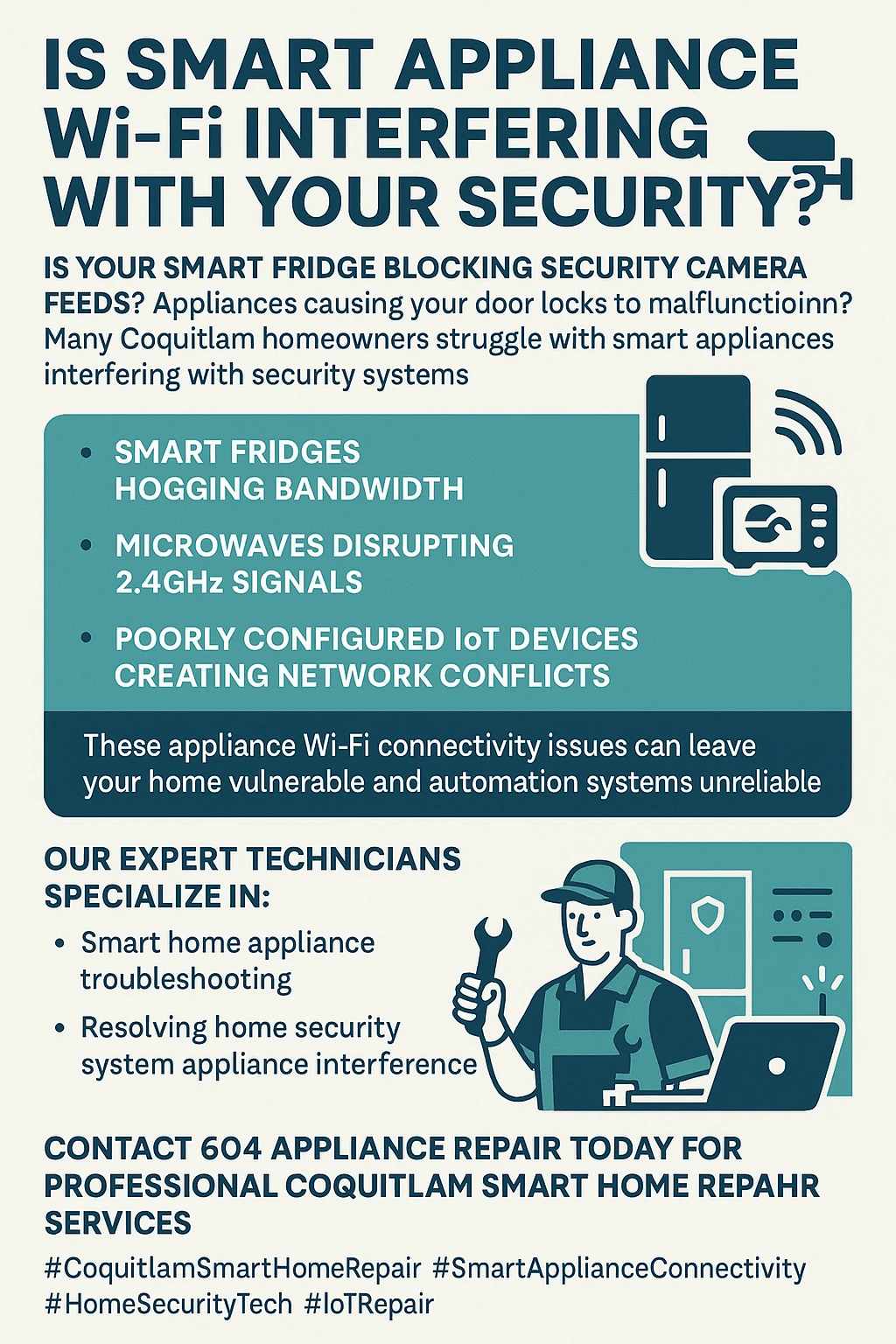
Understanding How Kitchen Appliances Sabotage Your Smart Home Security
The fundamental problem destroying smart home reliability in Coquitlam homes stems from a historical accident that occurred decades before WiFi technology even existed. Back in the 1940s, engineers discovered that electromagnetic radiation at 2.45 gigahertz could efficiently heat food by exciting water molecules—the core principle behind microwave oven operation. When the Federal Communications Commission created unlicensed frequency bands in the 1980s, they established the Industrial, Scientific and Medical (ISM) band around this same 2.4 GHz frequency that microwaves already occupied. Fast forward to the 1990s when WiFi engineers needed an available frequency band for their new wireless networking technology, and they naturally chose the same 2.4 GHz ISM band because it was open for unlicensed use.
What seemed like an elegant solution has become a connectivity nightmare as modern homes fill up with dozens of devices all trying to communicate on the same electromagnetic real estate. Your smart security cameras, door locks, motion sensors, and hub all rely on this 2.4 GHz band for communication, but they’re competing with microwave ovens, cordless phones, baby monitors, Bluetooth speakers, and increasingly, smart appliances like refrigerators and dishwashers that also need WiFi connectivity. The interference problem becomes exponential when multiple devices operate simultaneously, creating what engineers call a “spectral traffic jam” where signals from different devices corrupt and overwhelm each other.
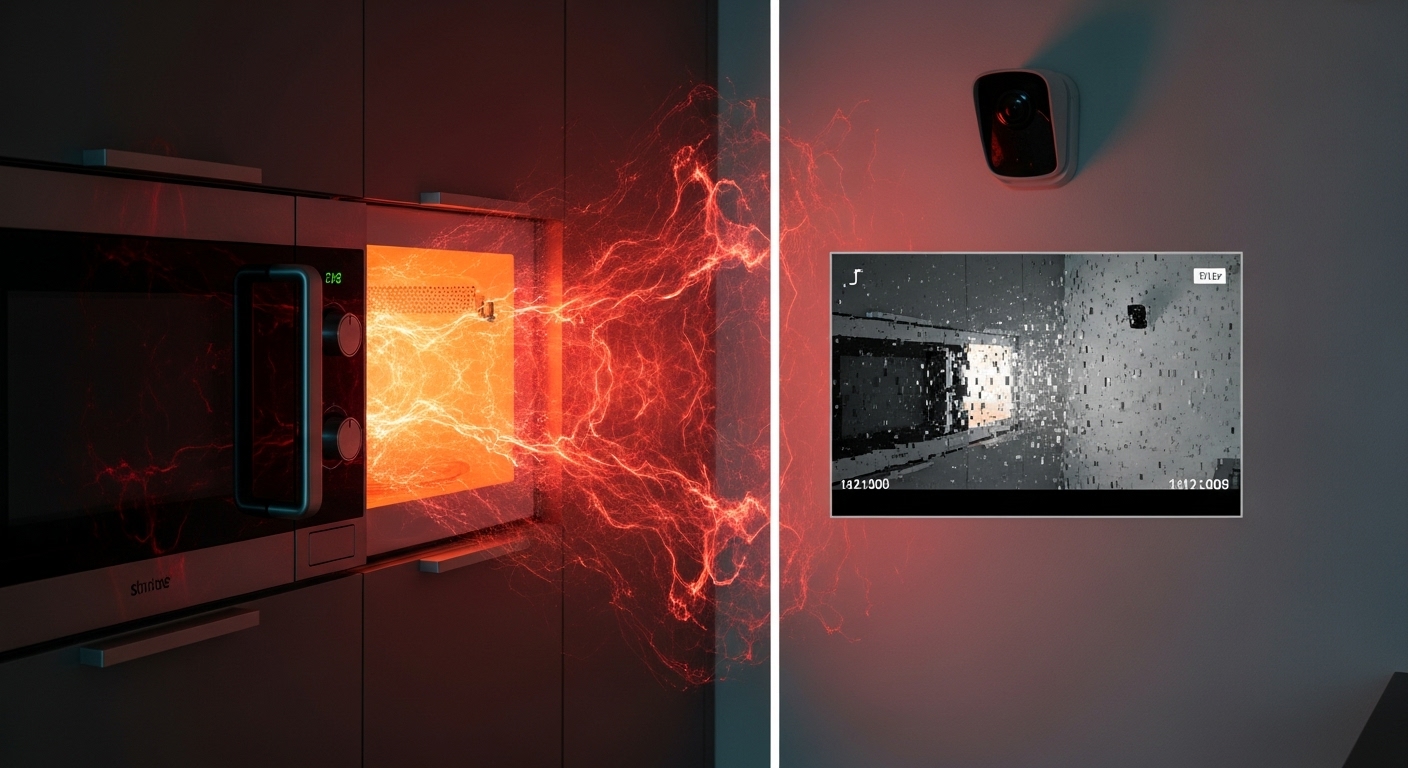
Modern kitchens amplify this interference problem because they’ve become electromagnetic battlegrounds filled with sophisticated appliances containing switching power supplies, inverter motors, and wireless communication modules. Your smart refrigerator isn’t just keeping food cold—it’s constantly uploading usage data through WiFi, downloading firmware updates, and communicating with cloud services for features like grocery list management and energy optimization. When this refrigerator operates simultaneously with a microwave oven leaking electromagnetic energy through degraded door seals, the cumulative interference can completely disable nearby security cameras and smart locks, creating dead zones in your home’s protective coverage.
The interference patterns follow predictable sequences that help identify the source of connectivity problems. Initial symptoms typically manifest as intermittent connection drops that correlate with specific appliance usage—security cameras losing feed when someone starts the dishwasher’s heavy-duty cycle, smart locks becoming unresponsive during peak cooking hours, or motion sensors triggering false alarms when the microwave operates. As appliances age and their electromagnetic shielding degrades, these interference episodes become more frequent and severe, eventually reaching a point where affected security devices simply cannot maintain stable connections to your home network.
Environmental factors unique to Coquitlam’s coastal location create additional electromagnetic challenges that inland communities don’t experience. Salt air contains corrosive elements that accelerate the degradation of electronic components in both appliances and security devices, potentially increasing electromagnetic leakage from aging microwaves while simultaneously making security system radio modules more sensitive to interference. The high population density in many Coquitlam neighborhoods compounds the frequency congestion problem, as neighboring homes contribute additional WiFi networks and electronic devices that further crowd the available spectrum.
The Microwave Menace: Your Kitchen’s WiFi Destroyer
Microwave ovens represent the single most destructive appliance interference source affecting smart home security systems, and understanding why requires examining both the physics of microwave operation and the deterioration patterns of electromagnetic containment systems. When your microwave’s magnetron tube activates to heat food, it generates electromagnetic waves at exactly 2.45 GHz—sitting directly in the center of the 2.4 GHz WiFi band that most security devices use for communication. The power differential is staggering: while your WiFi router transmits at approximately 0.1 watts, the microwave operates at roughly 1000 watts, creating electromagnetic energy that is literally 10,000 times more powerful than the delicate signals your security cameras and smart locks depend upon.
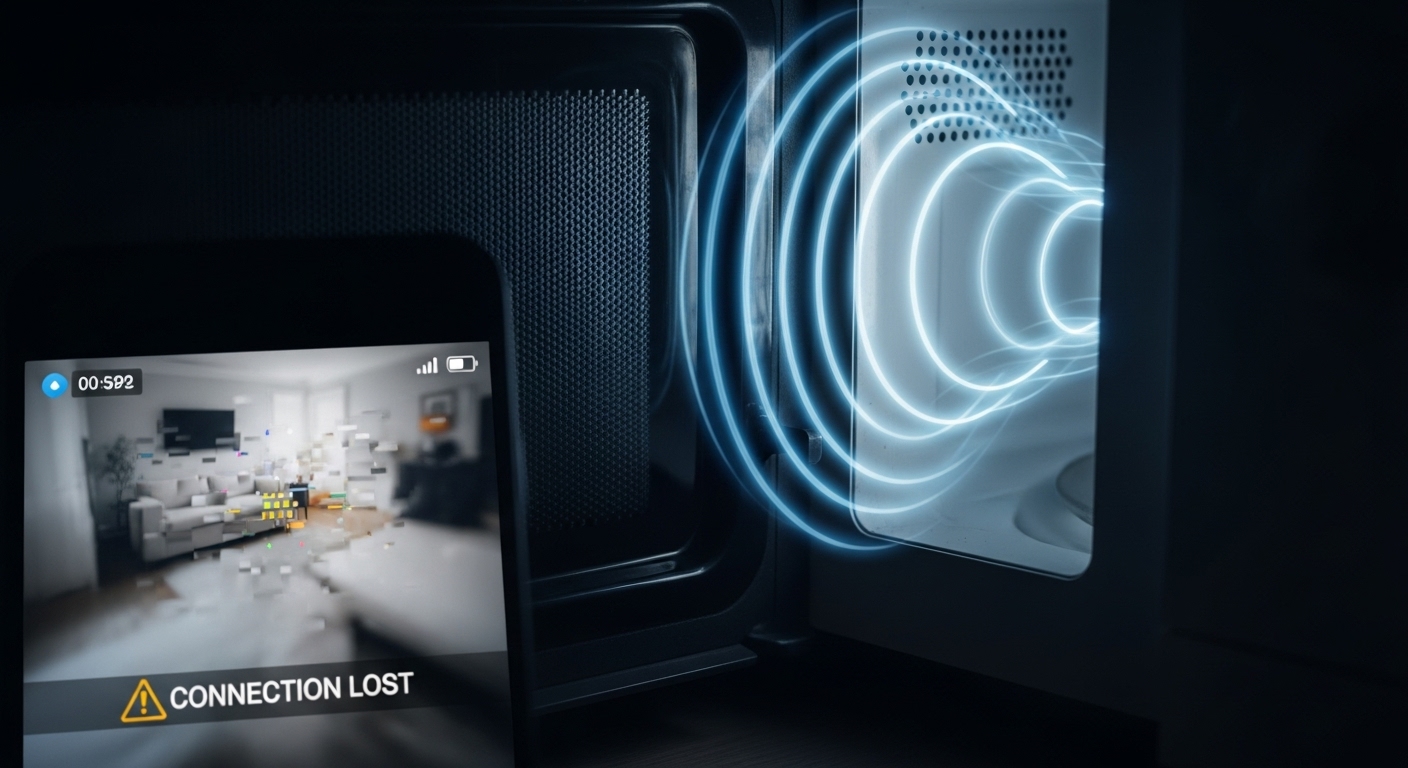
In theory, this power differential shouldn’t matter because microwave ovens are designed as Faraday cages—metal enclosures that completely contain electromagnetic radiation and prevent it from affecting nearby devices. New microwave ovens with perfect door seals and intact internal shielding should create zero WiFi interference, allowing your security system to operate normally even when the microwave runs at full power. However, real-world conditions differ dramatically from this theoretical ideal, and the rubber door seals that create the electromagnetic barrier inevitably degrade over time through thermal cycling, food debris accumulation, and simple age-related deterioration.
Even microscopic gaps in microwave door seals—cracks too small for the human eye to detect—allow sufficient electromagnetic energy to escape that nearby WiFi signals become completely overwhelmed. Professional RF engineers using spectrum analyzers have documented this phenomenon, showing dramatic electromagnetic energy spikes across the entire 2.4 GHz band whenever aging microwaves operate. The interference signature appears as a broad “hump” of energy rather than the sharp peaks characteristic of individual WiFi networks, making microwave interference relatively easy for trained technicians to identify when diagnostic testing is performed.
The diagnostic pattern for microwave interference follows a characteristic sequence that homeowners can use to identify the source of their connectivity problems. Security cameras positioned within range of the microwave will experience video feed dropouts or severe pixelation the instant someone activates the microwave, with video quality recovering immediately when the
